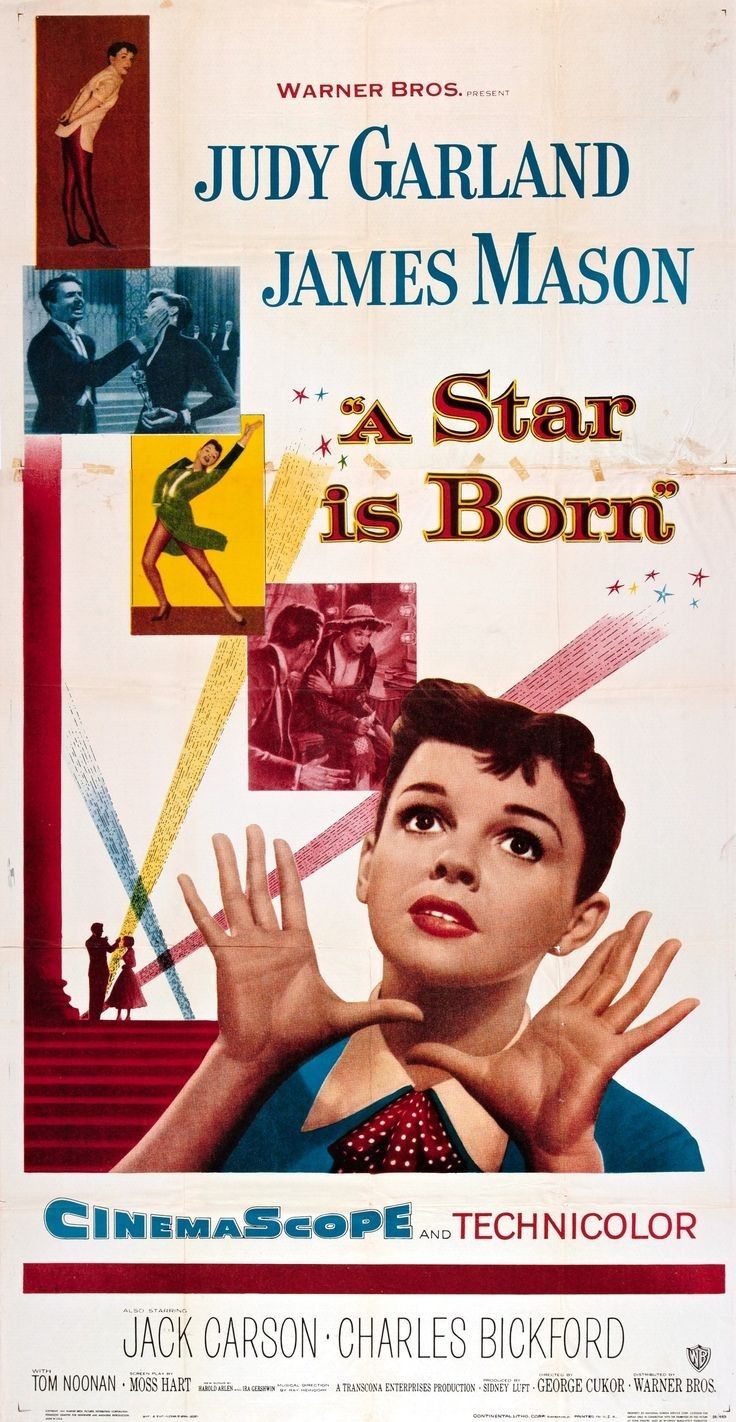
Don’t even bother arguing otherwise—this is the definitive A Star Is Born. Not because of George Cukor’s staging or the CinemaScope spectacle. It’s Judy Garland. The way her voice seems to catch light, the way her face carries every crack of feeling—it’s spellbinding. They called this Garland’s comeback, but it feels more like a coronation. This might be the best performance that she ever gave. She has that kind of perilous brightness about her. Like a lightbulb about to burst. Radiant but unstable. Then, before she flashes out, she’s laid bare—the sweat, tremor, and raw nerves that she tries to dress up as control. The fact that this trajectory seemed to echo the tragedy of Garland’s own career makes this feel even more poignant.
And when Garland sings, she really sings. These are moments you forget that there was ever supposed to be a plot. You might even barely notice there was a camera. It’s ethereal.
Garland plays Esther Blodgett, a band singer who is mid-performance when a blithering drunk decides he’s smitten with her and stumbles onto the stage—interrupting her mid-performance. But this isn’t just any ordinary drunk. He is Norman Maine (James Mason)—a world-renowned movie star. His career is in free fall, largely due to his alcoholism, but he still has enough pull to open the studio gates for Esther. And the next thing she knows, she’s under lights doing a screen test. He and Esther also fall in love with each other.
The title’s both promise and curse. Her star climbs as his burns out, and their love flickers in the space between. The mechanics of this story (this being the first remake of the 1937 original) have always been fussy—especially the third-act’s plunge into melodrama. But Garland’s too powerful for it to matter. Mason, for his part, gives her the space to burn—playing his own downfall in increments.
Director George Cukor, to his credit, knows when to step back. He keeps the camera close for Garland’s iconic performance of “The Man That Got Away,” surrounded not really by people but by shadowy brass and woodwinds. The scene lets her collapse in silence—and you can feel the regret lined on her expression. Later, when Norman crashes her Oscar speech, she gets pinned in a frame that won’t let her hide. Those subtle flicks between pride and fury showing the utmost conflicted moment going on within her. The musical numbers might provide the glitter, but it’s those smaller moments that truly stay with you. Those that show her subtle but widening cracks.
There’s also an excellent even if somewhat infamous sequence, “Born in a Trunk.” A 15-minute lavish musical showcase produced by the studio in post-production—Cukor had nothing to do with it—and it fundamentally adds nothing to the film. Still, it’s a wonderful number—a lavish showcase and mini-biography of this performer clawing her way from vaudeville to stardom. Born in a trunk, raised in vaudeville, conditioned to smile through exhaustion. Some have felt this was not just connected to the character Garland is playing on screen but also her real-life ascent to stardom.
If possible, find the restored version of this movie that runs about 178 minutes. Some missing scenes only have surviving audio and are supplemented with slide-show stills, but it fills in some of the plot and emotional gaps that the studio cut fumbled. Otherwise, some of the sequence-of-events from rise to ruin don’t quite connect. Overall, a grand studio epic that’s so buoyed by Garland that you’d be forgiven for thinking this was a one-woman show. She’s so compelling here that she’s not just playing a star being born. She’s the embodiment of what it costs to stay one.