THE FADED SPOTLIGHT

by Michael Lawrence

List of "T" Movies


Ticket to Paradise (2022) Poster
TICKET TO PARADISE (2022) C
dir. Ol Parker

A romantic comedy with exactly one selling point, and it has nothing to do with the story, the jokes, or even the scenery. It’s Clooney and Roberts—prestige movie stars whose charisma is potent enough to bulldoze through every cliché and flimsy plot point the movie throws at them. And this movie, an otherwise unrelentingly mediocre rom-com, has a lot of them.

Clooney and Roberts play a long-divorced couple dragged back into détente when their daughter Lily (Kaitlyn Dever), fresh out of law school, announces that she’s ditching the career waiting for her in Chicago to marry Gede (Maxime Bouttier). He’s a seaweed farmer she just met while on vacation in Bali, and her plan is to live the rest of her days on the island, joining him in the seaweed trade. Clooney and Roberts, understandably, think she’s hurling her future off a cliff. But instead of doing what any rational parent might—sitting her down, voicing their concerns, and hoping reason sneaks in through the cracks—they go straight to sabotage.

They arrive in Bali armed with smiles and toasts, posing as model parents. But underneath the performance, they’re running a covert operation. They whisper doubts into Lily’s ear. They see to it that vendors are mysteriously delayed. Wedding rings lifted and hidden at just the wrong moment. And when I say “covert operation,” I mean they don’t especially come off like they’re trying that hard. The film’s primary mission is to film Clooney and Roberts with Bali glittering behind them. The sabotage stuff gets more play in the margins. There’s a supporting cast, but they drift in and out like extras who couldn’t figure out how to move off camera, so they stayed a while. Even the central romance—the wedding everyone is supposedly here for—plays like filler.

What this movie really suffers from is relentless beige. It has no color unless Clooney and Roberts are on screen, and they’re able to break through with some slapstick or side-eye—a reflexive charm they can summon without even trying.

The highlight of the film happens, of all places, in a game of beer pong. Clooney and Roberts, shoved onto the same side, get drunk, get competitive, and—naturally—rekindle some of that old spark they had when they first fell in love. In another movie, a beer pong diversion would have been a frat-fueled throwaway, a bit of comic fluff to keep things loose. But here, in a film practically built out of throwaways, it works better than anything from the actual plot.

Ticket to Paradise coasts on faces we like to look at and little else. Whether that’s enough for you depends on how much pleasure you take in watching Clooney and Roberts share a frame—half-committed to smiling at each other through gritted teeth. None of it is unwatchable. But all of it fades just as quickly as it plays. This is a soft-focus comedy that drifts in, drifts out, gives you some postcard views, and ultimately dissolves into background noise.
Starring: George Clooney, Julia Roberts, Kaitlyn Dever, Billie Lourd, Maxime Bouttier, Lucas Bravo.
Rated PG-13. Universal Pictures. Australia/UK/USA. 104 mins.
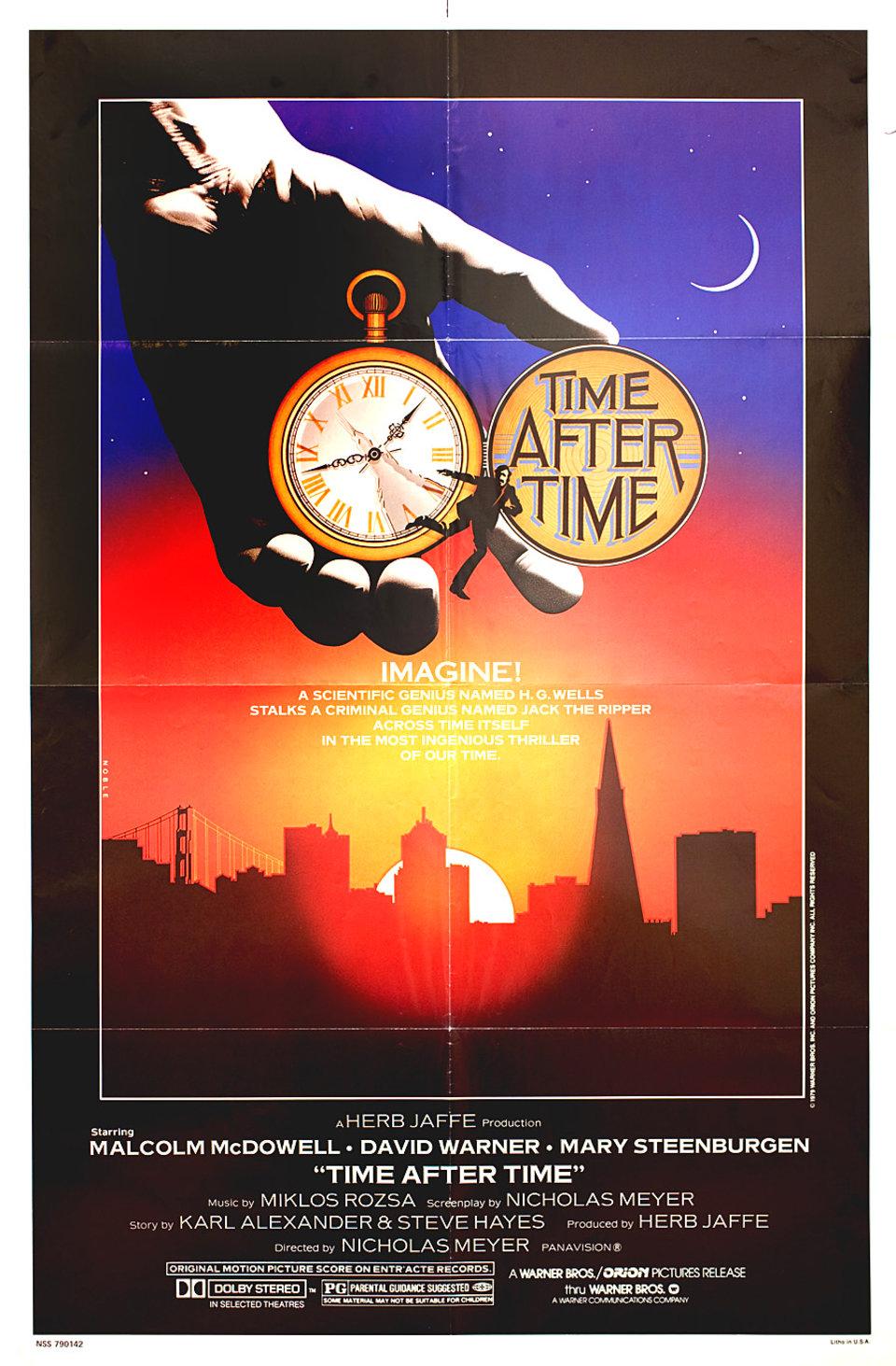
Time After Time (1979) Poster
TIME AFTER TIME (1979) B+
dir. Nicholas Meyer

An attractive twist on H.G. Wells’ The Time Machine. Not only do we get a retread of Wells’ classic story about a scientist who develops a time travel device and uses it to skip across centuries, but this one also throws Jack the Ripper into the mix. The result still gives you that melancholic kind of temporal seasickness unique to time travel movies, but it also adds a thriller angle that lends it the urgency of something double-parked.

Malcolm McDowell plays H.G. Wells as a proper, pipe-smoking humanist who believes progress and decency can go hand in hand. While he’s delivering polite speeches about utopia, one of his dinner guests—the outwardly affable Dr. John Leslie Stevenson (David Warner)—nicks the machine and takes off with it, just after being revealed as the man prowling London’s foggy streets and carving up women as Jack the Ripper. Wells follows and materializes in 1979 San Francisco. (Why San Francisco? Because that’s where the time machine ended up—in a museum, displayed as a curious artifact built by that famous author H.G. Wells.)

He steps over the velvet ropes of the exhibit and wanders outside, expecting flying cars and world peace, but instead finds strip malls, fast food, and televised bloodshed. What stuns him isn’t just the noise or the fashion—it’s how easily Stevenson blends in. A man who once killed for the thrill now finds himself in an era where the world hardly blinks at violence.

The fish-out-of-water (and fish-into-water) setup gives the movie room to play. McDowell makes Wells an appealing mix of intellect and panic. He quickly finds a love interest in a bank clerk named Amy (Mary Steenburgen), who takes Wells’ confession—that he’s a time traveler chasing a historical killer—more as a quirk than a red flag. They fall for each other with the kind of speed that only happens in movies or accidents.

David Warner, meanwhile, plays Stevenson with an eerie calm—Oliver Reed might have brought a few more shivers, but not many more. If the concept weren’t so strong, the film could have coasted on the actors alone. But beyond the cat-and-mouse mechanics, the movie pokes at bigger questions: the line between progress and decay, and how evil never dies, never even slows down. All it does is change outfits and keep walking.

This isn’t a slick film, exactly. The cinematography is flat, almost television in spots. The dialogue can feel clunky. But the intoxicating combination of sci-fi and chase film keeps shining through, brighter than the production that contains it. This is a sci-fi chase film, a darkly comic romance, and a philosophical shrug, all bundled under one trench coat. Not really a masterpiece, but one hell of a ride.

Starring: Malcolm McDowell, Mary Steenburgen, David Warner, Charles Cioffi, Kent Williams.
Rated PG. Warner Bros. USA. 112 mins.
Time Bandits (1981) Poster
TIME BANDITS (1981) A−
dir. Terry Gilliam

A rambunctious hopscotch through time and space. An off-the-wall and surreal comedy that has Monty Python fingerprints all over it—directed by Python veteran Terry Gilliam using a script he co-wrote with fellow Python Michael Palin, and augmented by a hysterical appearance from John Cleese himself.

The story begins in the bedroom of Kevin (Craig Warnock)—a quiet, history-obsessed ten-year-old whose encyclopedic knowledge of ancient civilizations, particularly Ancient Greece, is about to come in very handy. All of a sudden, he sees six dwarfs stumble out of his wardrobe in a panic. They are in possession of a stolen map that shows the locations of time holes—rips through the fabric of time and space where they can walk through in one time and place and emerge someplace completely different. Right now, the dwarfs have emerged through a hole that came out of Kevin’s closet. Furthermore, they are being chased—by the Supreme Being himself, who manifests as a sort of Wizard of Oz–type disembodied head that tells them they’d better return the map or else.

The dwarfs, each with the disposition of a disgruntled ex-employee, are planning on using the map for their own nefarious purposes. That is, they are hopping through eras with the intention of looting history blind. Gold, jewels, priceless works of art—that sort of thing. Kevin ends up tagging along, quickly becoming the de facto conscience of the group and a sort of pint-sized Snow White with a Socratic streak.

What follows is a jittery, headlong journey as these seven figures jump from one historical detour to the next, with an intoxicating kind of manic energy and a crowded production design that looks like it was assembled from childhood nightmares and toy boxes.

Among the historical figures they encounter are Napoleon (Ian Holm), who cackles at puppet shows and ranks generals by height; Robin Hood (Cleese), a grinning PR machine who cheerfully thanks the poor as he hands them stolen goods; and Sean Connery as the surprisingly warm-hearted Agamemnon, who briefly adopts Kevin as his son in what feels like a better life path. (The dwarfs end up snatching him back, an action that leaves Kevin absolutely livid.) At every turn, not only are they continually haunted by the Supreme Being, they also find that Evil himself (David Warner) is interested in that rolled-up piece of cloth they’re carrying around. Evil is a bureaucratic tyrant in a cape who is often seen vaporizing minions mid-sentence. One of his dreams for the world is to replace every tree with a computer.

For all the visual madness and storybook lunacy of this film, what keeps it steady is that the characters react to it all like people would. It’s one of the rare kids’ films that doesn’t stoop, smooth anything over, or stop to explain. This is like a pop-up book where logic mostly gets in the way, wonder isn’t always friendly, and the tone stays irreverent. But the emotions sneak up on you anyway, simply because you believe the characters.

Time Bandits plays like an anti-fairytale. A wacky shack thrill ride. It’s messy, funny, and unexpectedly moving—and even manages to find a bit of wisdom between pratfalls.

Starring: Craig Warnock, David Rappaport, Kenny Baker, Jack Purvis, Ian Holm, Sean Connery, Michael Palin, John Cleese, David Warner, Ralph Richardson.
Rated PG. Handmade Films. UK. 110 mins.
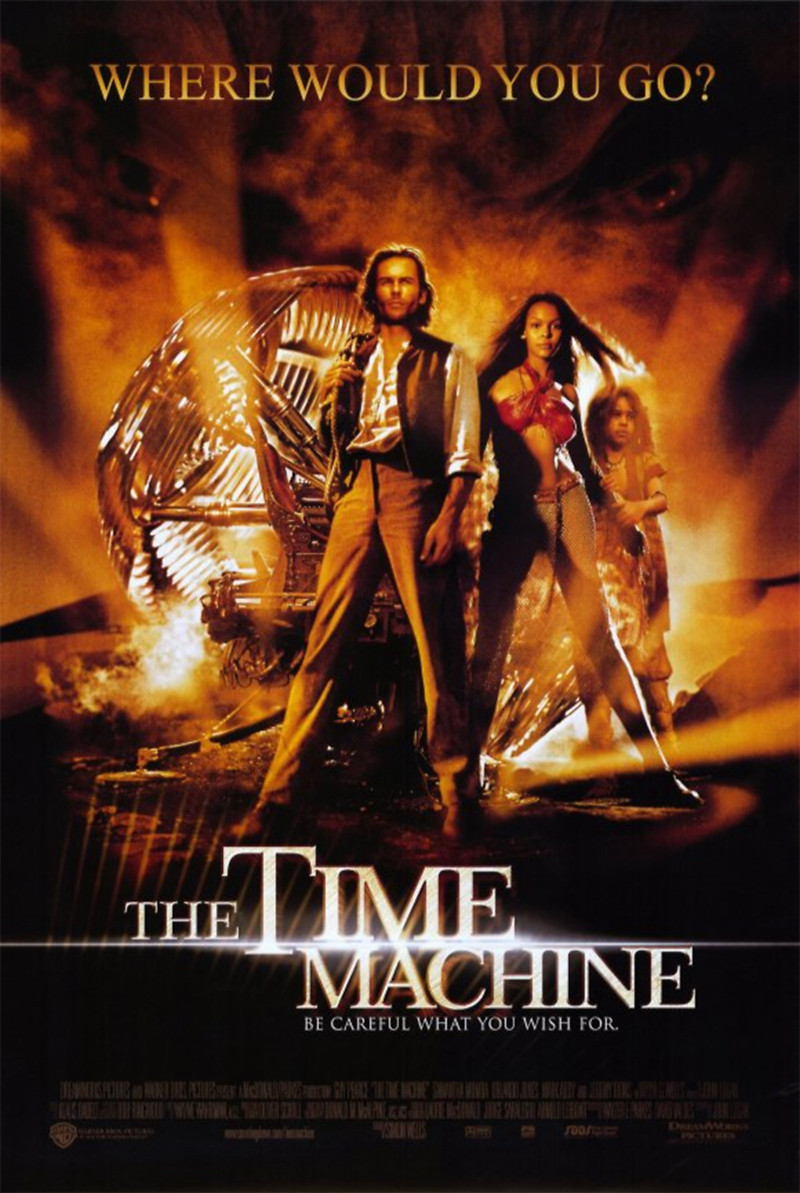
The Time Machine (2002) Poster
THE TIME MACHINE (2002) B−
dir. Simon Wells

A gleaming, overclocked remix of the H.G. Wells story that ditches the thoughtful sci-fi parable of the source material in favor of standard action-adventure, with time travel as an excuse. (One could blame this on Hollywood being soulless, but they did bring on Wells’ great-grandson Simon Wells to direct. At least if they were going to butcher the novel, they kept it in the family.) The film is slick, often silly, occasionally striking, and not concerned at all with making sense. And yet, I kind of liked it.

Guy Pearce plays Alexander Hartdegen, a mop-haired inventor in 1899 New York who builds a time machine after losing the woman he loves (Sienna Guillory). His goal isn’t distraction from grief but to undo the event entirely. But the past refuses to cooperate—he saves her from one horrible fate only for her to meet another. The universe, it seems, is made of stronger stuff than a time machine can penetrate.

So instead of looking to the past for answers, he looks to the future. But what he finds isn’t promising. First stop: 2030, where the moon is collapsing in on itself (don’t ask). Then much farther—eight hundred thousand years into the future, where humanity has split into two species: the Eloi, who live in cliffside huts and speak in strange metaphors, and the underground Morlocks, cannibals who hunt the Eloi like livestock.

The film makes a few philosophical gestures about fate and regret. But mostly, this is a chase movie in sci-fi clothing. The logic’s paper-thin—characters in the deep future seem to know more about Hartdegen than he knows himself. Why or how his tiny incursions through time and space stuck in their collective memory feels far-fetched. And it’s odd that the Eloi settlement looks so utopian when the population is supposedly being ravaged by cannibals.

Still, if you take this as a theme park ride rather than a classic sci-fi tale, it’s not a bad watch. The scenery looks great, reminding me of those CD-ROM adventure games like Riven I used to play in the ’90s—except far more vivid than computers could render at the time. The Morlock design is pure nightmare fuel. And Pearce, even saddled with clunky exposition, makes for a solid time-hopping lead.

This isn’t a terribly smart film, but it’s not lazy either. Just a polished, weirdly watchable relic from that brief window when studios thought “dumb, but pretty” was enough to count as science fiction. And to be fair, sometimes it is.

Starring: Guy Pearce, Samantha Mumba, Jeremy Irons, Orlando Jones, Mark Addy, Phyllida Law.
Rated PG-13. DreamWorks Pictures. USA. 96 mins.
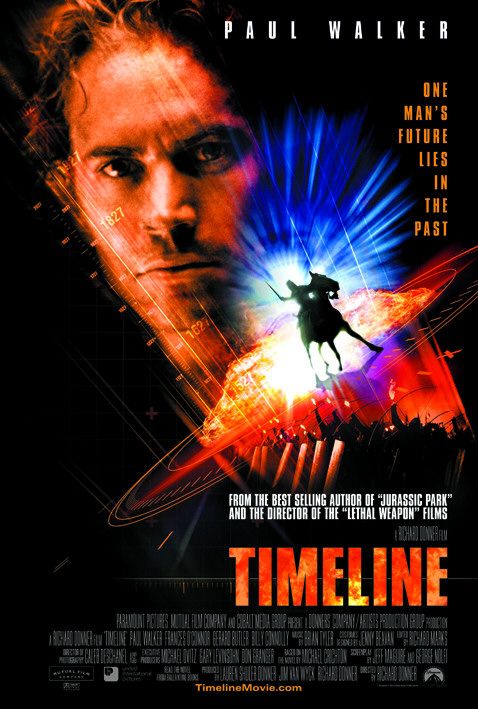
Timeline (2003) Poster
TIMELINE (2003) C+
dir. Richard Donner

What’s most baffling about this movie (and, for that matter, the Michael Crichton source material it adapts) is how much time it spends in its opening scenes trying to convince us that time travel might actually be possible. These buttoned-down characters present their theories like they’re already airtight, as if all you need to do is get yourself a sterile lab, assemble the machinery, and you’re good to go. They present diagrams and equations. They go into long digressions about quantum foam and wormholes. It’s all so intense that you start to wonder if you’ve accidentally wandered into a graduate seminar as opposed to watching the setup for a science fiction film.

But the minute this handful of archaeologists and interns actually step through the wormhole, that whole pretense of scientific plausibility is dropped like a bowling ball off the top of a high-rise. The depiction of 1357 France is about as realistic as a floor show at Medieval Times. These ostensible nerds find themselves swept into sword fights, sieges, and jousts—and are not only competent, but it’s like they’ve been training for it for years. Martin Lawrence basically did this same trick in Black Knight, except there wasn’t any science talk. All he did to travel through the fourth dimension was fall into a moat. This film’s worst transgression, though, is that everyone speaks perfect English, allowing them to move and communicate through medieval France just as easily as they would through mid-state Ohio. Of course, that’s not uncommon in fantasy films, but after all that straitlaced talk of physics and scientific realism, it would be nice if there were also some realism in how modern people might actually try to move through the past.

That said, I wouldn’t count this film as a total loss. The action is a bit standard-issue, but at the same time, it’s competently staged. There’s also a good, tactile, dirty texture to the sets that at least starts to sell the illusion. And the cast—Paul Walker, Frances O’Connor, Gerard Butler, Billy Connolly—keep straight faces the whole way through, which makes you think nobody told them how silly this whole thing really is.

By the end, Timeline feels like a school trip that went a little sideways. It’s not clever, it’s not seamless, but it’s not boring either. As sci-fi it’s frustrating. As a medieval adventure it half works. You might even find you enjoy it—depending on your willingness to drop your standards along with the drawbridge.

Starring: Paul Walker, Frances O’Connor, Gerard Butler, Billy Connolly, David Thewlis.
Rated PG-13. Paramount. USA. 116 mins.