THE FADED SPOTLIGHT

by Michael Lawrence

List of "F" Movies


Friday (1995) Poster
FRIDAY (1995) B
dir. F. Gary Gray

Craig (Ice Cube) is sunk into the front steps of his South Central home, waiting out the morning like he’s daring it to do something. The only motion out there is a thin line of smoke from something somebody lit two houses over.

Then Smokey (Chris Tucker) blows in, and quiet no longer stands a chance. He moves like he’s constantly dodging invisible projectiles. His grin keeps flipping itself over. And the words spill so quickly that it feels like the porch took on extra tenants. Smokey’s the neighborhood’s unofficial weed envoy. “Diplomat” is the polite word, though diplomacy isn’t exactly in his skillset. With him around, the porch ceases to be a place of tranquility and becomes a launchpad for whatever hare-brained mission Smokey’s already halfway through describing.

What comes next isn’t plot so much as tumbleweeds. Things roll in, roll out, bump into Craig and Smokey, and puff into nothing. The plot doesn’t build so much as wander. It zigs here, zags there, cutting corners while hiccups and interruptions wander up the sidewalk like they’re dropping in for the afternoon. A drug debt. A bully stomping around the block. A bit of flirting hanging in the air. Those tiny annoyances that balloon just because you’re bored and your head won’t stay quiet.

Cube plays Craig in a sort of worn-down glide. Jokes bubbling up when they feel like it, and his eye-roll is not far behind. Tucker’s another story entirely. He’s a sparkler in a closed room—fast talk and ricochet energy. Together, the two are motion in opposite directions. Craig horizontal and Smokey straight up the wall.

Through it all, though, John Witherspoon steals the movie in those cracked-wonder monologues of his as Craig’s father. He shows up ready to unload whatever thought’s been rattling around in his head since breakfast, and whoever’s closest gets drafted as the audience. He isn’t the center of the film, but every time he barges in, you know it’ll be for some kind of twisted reason—a toilet complaint, a rant about the lack of pig’s feet in the fridge, the virtues of being a dog catcher when you don’t even like dogs. He throws off lines you remember longer than the plot they’re in.

For a film that looks this loose, it ends up surprisingly sticky. A dozen throwaway moments stick around in your head. So does the slang. So does the pleasure of a comedy that feels like it invented itself on the breeze. The film doesn’t even seem to notice when it drops “Bye, Felicia.” Yet the line marched off on its own and became public property.
Starring: Ice Cube, Chris Tucker, Nia Long, Tiny “Zeus” Lister Jr., John Witherspoon, Regina King, Anna Maria Horsford, Bernie Mac, Faizon Love.
Rated R. New Line Cinema. USA. 91 mins.
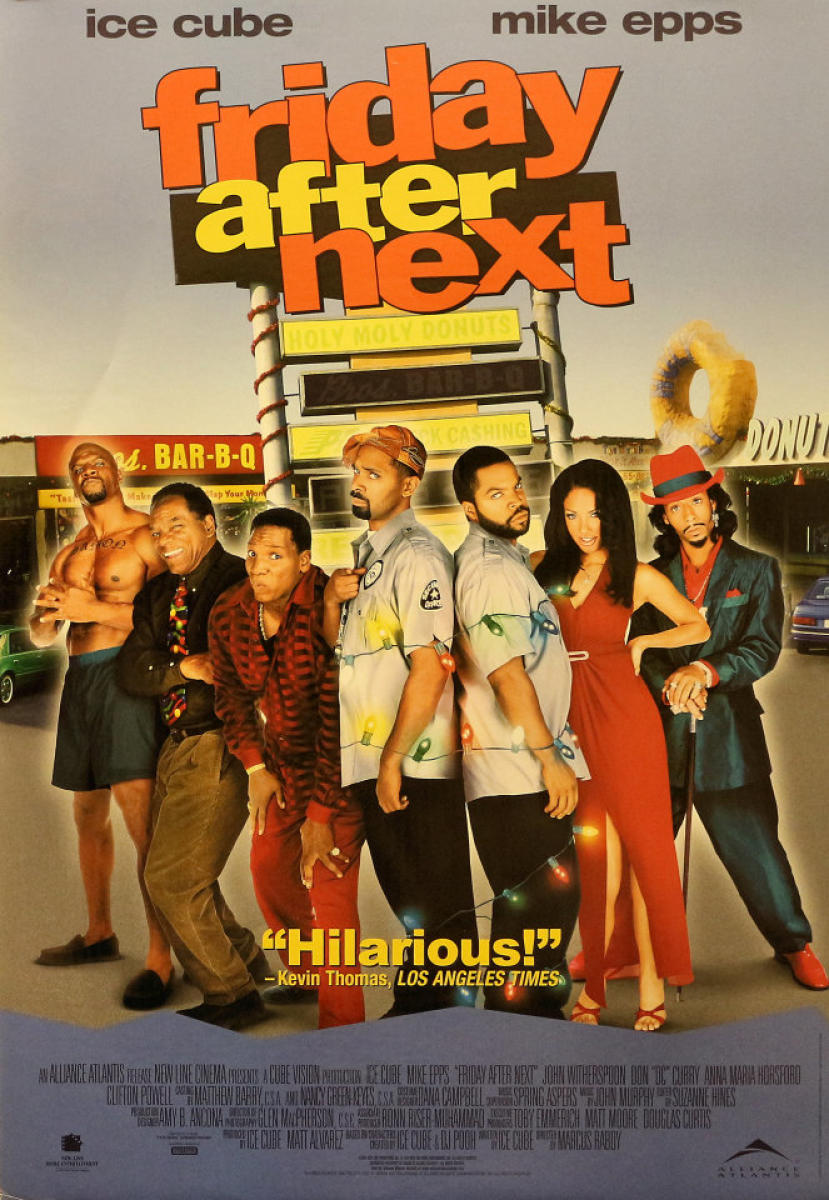
Friday After Next (2002) Poster
FRIDAY AFTER NEXT (2002) C+
dir. Marcus Raboy

It’s December in South Central, but things are mostly the same apart from a decor shift or two. Craig and Day-Day (Ice Cube and Mike Epps) are rent-a-cops now, patrolling a strip mall in cheap uniforms with badges that glimmer like they’re promising bravery neither man intends to supply. They hate the work, they’re lousy at it, and yet that’s not even what’s got them spun out today. It’s the mess left over from last night.

A fake Santa in a dingy suit crawled in through their window, wrecked the place, then vanished with their rent money. Money that they’d barely managed to scrape together as it was—and there’s no chance they can do it again. The rent is due today, and Miss Pearly (Bebe Drake), their landlord, runs her building with a smile that lasts right up until you owe her a dollar.

So the cousins spend the day trying to track down their knockoff Santa while keeping Miss Pearly at bay. All the while, that strip mall has a way of coughing up trouble whenever they walk past a doorway.

There are some fun additions to the supporting cast. Terry Crews as a freshly paroled wall of muscle walks off with the most attention—a man who would smile at you in such a way to make you want to step to the side. Katt Williams plays Money Mike—a pint-sized pimp running a boutique so cramped it might as well be a closet. It’s stocked like somebody raided a thrift store and arranged the leftovers mid-hallucination.

John Witherspoon’s back too. Now running a barbecue stand now, with a tag line that he proudly keeps repeating: “Tastes so good, make you wanna slap yo’ mama.” Witherspoon still slips in the film’s best muttered asides, but you can’t help wishing it slowed down enough for it to stir in a few extra.

You get bursts of real humor here—little bright sparks—which for my money makes this a significant improvement over Next Friday. But most of it is gone before they’re allowed to pop. It’s a nightmare of timing. Everything moves in little lunges. So impatient that the jokes barely get a moment to exist. And by the time the movie reaches the end credits, there’s no real sense of arrival. Just the feeling that it ran out of scenes.

Starring: Ice Cube, Mike Epps, John Witherspoon, Don “D.C.” Curry, Anna Maria Horsford, Clifton Powell, Terry Crews, Katt Williams, Bebe Drake, Rickey Smiley.
Rated R. New Line Cinema. USA. 85 mins.
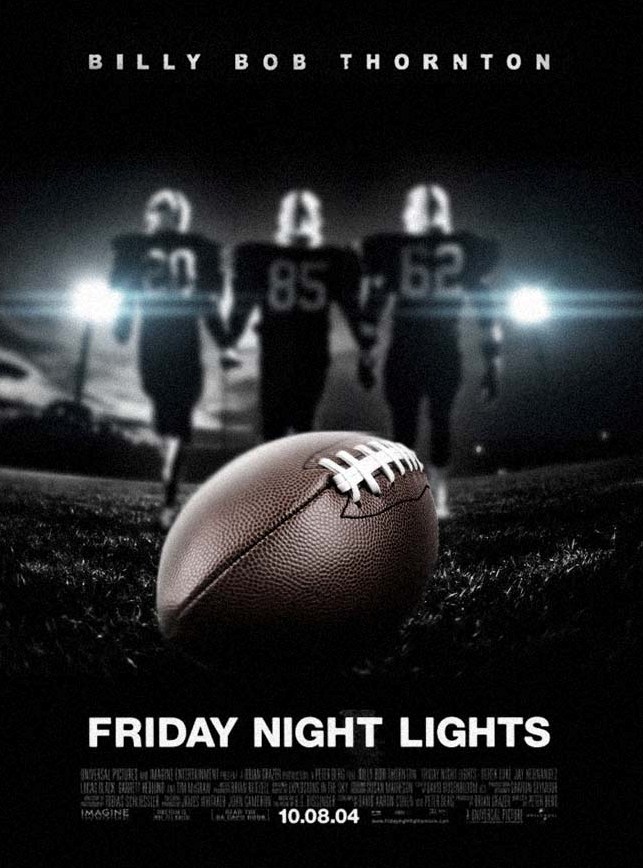
Friday Night Lights (2004) Poster
FRIDAY NIGHT LIGHTS (2004) B+
dir. Peter Berg

By 2004, the jittery handheld style was everywhere, but high-stakes, small-town Texas football might be the one place where it actually makes sense. Friday Night Lights rides that look hard—fast cuts, nervous zooms, plays that feel snatched rather than staged. And for this story, such agitation fits. There isn’t a whole lot of narrative depth here, but the atmosphere settles in like its own little pressure system.

The film made a splash when it opened, and a big reason for that is it never pretended high school football—for the kids, anyway—was just a game. It’s pressure, fantasy, and reckoning with a community that lifts teenagers onto pedestals only to walk away the second that they slip.

Boobie Miles (Derek Luke) is the clearest example. He’s already plotted for a lucrative career the NFL, and people treat him like an investment more than a kid. But all it took was a torn ligament and poof, his future evaporates. His subsequent breakdown in his car is utterly heart-wrenching. Curled into himself and pleading between tears to whoever’s listening, “What am I gonna do now?” But the movie isn’t just about Boobie. It’s more of a macro-view of the team—the Permian Panthers in Odessa, Texas—and the stakes at play.

Most of the players blend together after a while, but the film gets their world right. Locker rooms that go quiet in that way unique to teenagers who are about to be watched by an entire town. The quick prayers said more from habit than belief. And the kinetic energy when they hit the field—you can feel every collision echoing the town’s expectations. Billy Bob Thornton plays Coach Gaines as someone bracing for impact, as he tries to keep the town appeased, steady his boys, and the uneasy feeling that it all might be slipping away from him.

It walks the same route most sports movies do—body gives out, morale drops, team regroups, everything rides on one night—but it moves through it with a different pulse. But what makes this a far more compelling sports film than average is it never lies about what any of it means. Winning never fixes anything. Football is treated in some communities as a shared delusion than a sport. For many of the players, it’s a last hope of being part of something that matters before the real world comes by after graduation and sweeps the field clean.

This isn’t a rousing, rah-rah type of football movie. It isn’t supposed to be. This is high school football as a study of quiet collapse. Stylized, tense, and just clear-eyed enough to hurt.

Starring: Billy Bob Thornton, Derek Luke, Lucas Black, Garrett Hedlund, Jay Hernandez, Tim McGraw.
Rated PG-13. Universal. USA. 118 mins.
Fried Green Tomatoes (1991) Poster
FRIED GREEN TOMATOES (1991) B+
dir. Jon Avnet

This movie is like a pile of memories. There are truths, bigger emotions, and things that like to sort of wander until they choose a point to land on. Evelyn Couch (Kathy Bates) winds up at an Alabama nursing home because her husband’s Aunt Vesta is parked there, and somebody in the family has to show a face. Evelyn doesn’t have much use for Vesta, though, so she retreats to the visitors’ lounge, where her plan is to blend in with the wallpaper until she can finally make a break for it. But no such luck. Another resident, Ninny Threadgoode (Jessica Tandy), locks onto her and starts telling her a story like she’s been waiting years for an audience.

Ninny’s stories keep coming back to a girl named Idgie Threadgoode (Mary Stuart Masterson). Not your typical Southern belle. She grew up wild—wild hair, wilder temper—and no real interest in letting anyone smooth her out. She adored her brother Buddy, but a train took him out of her life, and she turned her grief into pure defiance. Ruth Jamison (Mary-Louise Parker) was Buddy’s old sweetheart—gentle, church-raised, the sort of woman the Threadgoodes always assumed would stay on the right path. Years after the accident, she circles back into Idgie’s life. She married the wrong man. A violent man. And she carries around a world full of hurt.

Idgie greets her with the usual swagger. But the space between them shifts fast, into a bond nobody in town has the vocabulary for. Could be sisterly, it could be something completely different, but naming it wouldn’t get you any closer. So they make something together instead—a small refuge. They call it the Whistle Stop Café. It’s a little pocket of the world where they cook, keep an eye out for each other—and whoever else happens to wander in its doors.

The film keeps jumping between eras while Ninny sifts through her memories. She treats them like loose photos. Some she holds up to the light, others she barely touches.

Evelyn stops pushing back. The stories slip inside and start shifting things around before she even realizes it’s happening. She’s spent years folding herself down to size, but Ninny’s tales start to pull at her from the opposite direction. You can see it arrive in pieces. Her shoulders easing off their guard—her voice finding a calmer register. It’s like a window that she thought was shut tight years ago is finally starting to give.

Not every detour pays off. There’s a murder trial that comes out of left field, and some other tonal shifts that happen so suddenly that they make the film skid a little. But the performances keep the film steady. Masterson gives Idgie this restless, buzzing intelligence. Parker finds the steel tucked under Ruth’s gentleness. Tandy plays Ninny with a soft, nostalgic glow. She edits the truth as she goes, smiling through the omissions, because precision isn’t what she’s selling.

It isn’t a neat film, but you get pulled into it. The plot isn’t the thing you walk away thinking about. It’s how the movie stays close to its people—settling in beside them, giving them room to breathe. Plenty of films treat the past with sharper lines and more polish, but not many have this much faith in ordinary folks helping each other through the world.

Starring: Kathy Bates, Jessica Tandy, Mary Stuart Masterson, Mary-Louise Parker, Cicely Tyson, Chris O’Donnell, Stan Shaw, Gailard Sartain.
Rated PG-13. Universal Pictures. USA. 130 mins.
Friendsgiving (2020) Poster
FRIENDSGIVING (2020) C-
dir. Nicol Paone

A Friendsgiving movie that feels like a potluck where every dish arrived from a different universe. Nothing matches. Nothing blends. Everything’s loud.

Malin Akerman and Kat Dennings play Molly and Abby. They’re just trying to pull off a simple dinner. They’ve invited a few friends. They expect it to be small. But then their door keeps opening. Misfits, wild cards, and the kinds of relatives who only show up when there’s food involved. In theory, should have been a perfectly fine setup for a madhouse holiday comedy. This sort of film has its own well-worn cinematic lineage—and the decent ones will usually evolve into something warm or a little wicked. But this one just keeps tripping over its feet.

The whole thing skitters along like it’s afraid to stop moving. The jokes escalate only one way—getting louder. There’s sniping, flailing, competing for the last word. And somehow nobody’s funny. You can even watch the actual comedians here—Wanda Sykes, Margaret Cho, Aisha Tyler—working overtime, trying to carve jokes out of air. But the script only hands them utensils from the kids’ table.

And right when you think you might have adjusted to the noise, the movie jerks into “heartfelt moment” mode. No buildup or groundwork. It’s just a moment dropped in your lap with hopes that you’ll feel something before the movie sprints back into noise.

It’s not an unwatchable film. It’s not much of anything. Just a lot of talking, a lot of flailing, and that hollow aftertaste you get when you’re at a party that already feels like it’s run too long and you’re only seven minutes in.

Starring: Malin Akerman, Kat Dennings, Aisha Tyler, Chelsea Peretti, Christine Taylor, Jane Seymour, Deon Cole, Wanda Sykes, Margaret Cho, Fortune Feimster, Jack Donnelly, Ryan Hansen.
Rated R. Saban Films. USA. 95 mins.
The Friendship Game (2022) Poster
THE FRIENDSHIP GAME (2022) D+
dir. Scooter Corkle

It opens with a kind of Twilight Zone stillness. A story about something strange that never should’ve been sitting there among everyday things. Here, it’s a strange orb at a yard sale, hiding in plain sight among the old mugs and knickknacks. Four teenagers—Zooza, Cotton, Courtney, and Rob—spot the object and circle it. It’s so curious they might just bring it home. Then a mysterious lady appears out of the blue and conveniently tells them what it is. It’s something called “The Friendship Game.” A circle of friends touch the orb, make a confession, and the game judges the strength of their friendship. It’s a strong enough set up for me to want to know what happens next, but then the film lets go of it all mid-stride—as if it forgot what it set out to do.

The first odd thing that happens is Cotton (Kaitlyn Santa Juana) vanishes. It happens at a party, where she starts acting on edge, distracted. She’d started claiming she was seeing things the others couldn’t—pulling Courtney (Kelcey Mawema) aside to warn her about something the orb “showed” her. But she couldn’t quite get the words out. Later that night, Courtney glimpses Zooza and Rob (Peyton List, Brendan Meyer) in a moment that feels wrong to her. Maybe it was a vision, maybe not. Then, the next morning, Cotton’s gone. Not “mysteriously abducted” gone—erased. Like the movie misplaced her in the shuffle.

After that, the story splits in too many directions. Zooza makes a halfhearted attempt to figure out where Cotton went, but most of the actual digging comes from a kid she babysits (Dylan Schombing). He somehow gets access to Cotton’s webcam recordings and starts combing through them as if he’s the only one who got the memo to look into this. The story keeps jumping to unrelated scenes. Scenes of friends arguing, classmates wrapped up in side drama, many little moments that never come back around and join the rest of the film.

There should have been enough in the premise and setup for a solid supernatural mystery—with people vanishing and strange footage turning up in ways that point to the orb. The movie dutifully introduces all of it, but follows through with none of it. And whatever meaning the orb was meant to hold—fear, guilt, friendship—gets buried under all the story’s loose ends.

Starring: Peyton List, Kaitlyn Santa Juana, Kelcey Mawema, Brendan Meyer, Dylan Schombing, Miranda Edwards.
Unrated. RLJE Films. USA. 87 mins.
Fright Night (2011) Poster
FRIGHT NIGHT (2011) C
dir. Craig Gillespie

The 1985 film shifted between funny and strange with no hesitation. The remake follows the same general idea, but the feel of the original doesn’t carry over—even a whit. You can see the effort, but not the personality.

Charley (Anton Yelchin) is a Vegas teenager caught in the regular high-school shuffle. He has friends drifting away, a girlfriend he’s not sure he deserves. Then his normal teenage rhythm slips when he starts noticing things about his new neighbor, Jerry (Colin Farrell), that don’t feel right. For example, Jerry supposedly works construction. But he works the night shift. A dumpster full of concrete lands in the driveway and never leaves. Jerry calls it “foundation work,” and maybe it is, but Charley also sees him digging outside at hours no real contractor would choose. Jerry also starts asking oddly specific questions of Charley, and the place feels particularly shut in during the day—blackout windows. But things start to reach a fever pitch when some of their other neighbors are disappearing—including a boy who goes to his school.

Jerry—who notices that Charley is studying him—watches Charley back with this steady, amused look. Charley looks for any reason to call the authorities about things Jerry is doing. But all he does is give off the kind of threat you can feel but can’t prove. After Charley is pretty sure Jerry is a vampire, he turns to a supposed expert—Peter Vincent (David Tennant). He’s a Vegas showman in full vampire-slayer drag, but his confidence disappears as soon as actual trouble arrives.

The movie keeps tipping its hat to the original but never plants its feet. The big scenes blow in with plenty of volume but no tension. There are jokes here and there, but they show up fast and vanish faster. Tennant, to his credit, attacks his role like he’s trying to yank the film into something stronger. But the camera seems to have trouble sticking with him. Farrell, for his part is magnetic. He doesn’t fight for attention—he gets it. When he walks in the frame, the movie seems to focus a little more.

It works better when you’re not giving it full attention. You might find yourself perking up when Farrell is on screen—who seems to find ways to amuse himself and giving the film the few sparks that it has. But it never builds the personality the original had. The version I’ll always go back to is still the one with the tube-TV glow.

Starring: Anton Yelchin, Colin Farrell, Christopher Mintz-Plasse, David Tennant, Imogen Poots, Toni Collette, Dave Franco, Reid Ewing, Will Denton, Sandra Vergara, Lisa Loeb, Brian Huskey.
Rated R. Walt Disney Studios Motion Pictures. USA. 106 mins.