THE FADED SPOTLIGHT

by Michael Lawrence

List of "B" Movies


The Break-Up (2006) Poster
THE BREAK-UP (2006) B−
dir. Peyton Reed

Vince Vaughn is good at spinning nothing into something. His rapid-fire riffs pile up with sidebars and tangents. They move with such velocity that you almost forget the movie underneath them is a very standard romantic comedy.

He plays Gary, a Chicago tour guide who’d rather come home, kick back, and sink into video games than pitch in with the social upkeep his girlfriend Brooke (Jennifer Aniston) expects. Brooke is an art dealer who thinks a relationship should involve more than burping through dinner prep. Their romance collapses early. Neither of them moves out. They stay in the condo. Locked in a low-grade domestic war that doesn’t stop even after things get ugly.

The story gestures toward a will-they-won’t-they. What you end up watching most of the time is Vaughn running his mouth while Aniston volleys back with eye rolls and sharply timed retorts. Aniston isn’t exactly a live wire, but she’s also not yielding much either.

Peyton Reed keeps the direction deliberately plain. Almost TV-neutral, which puts nearly all the pressure on the actors to generate momentum themselves. And to their credit, they do. Vaughn thrives in that looseness. Aniston steadies it. The movie isn’t shaped to their energy as much as it gives them space to carry the scenes.

The supporting cast juices things further. John Michael Higgins, in particular, is hysterical as Vaughn’s manic brother-in-law, who drags his over-enthused a cappella friends into sing-along interventions meant to coax the couple back into line.

The digressions are often funny, but they don’t push things forward. What you’re really watching is the friction between the two leads. Vaughn talks in circles. Aniston digs in. The rest is just waiting.
Starring: Vince Vaughn, Jennifer Aniston, Joey Lauren Adams, Cole Hauser, Jon Favreau, Jason Bateman, Judy Davis, Vincent D’Onofrio, John Michael Higgins.
Rated PG-13. Universal Pictures. USA. 106 mins.
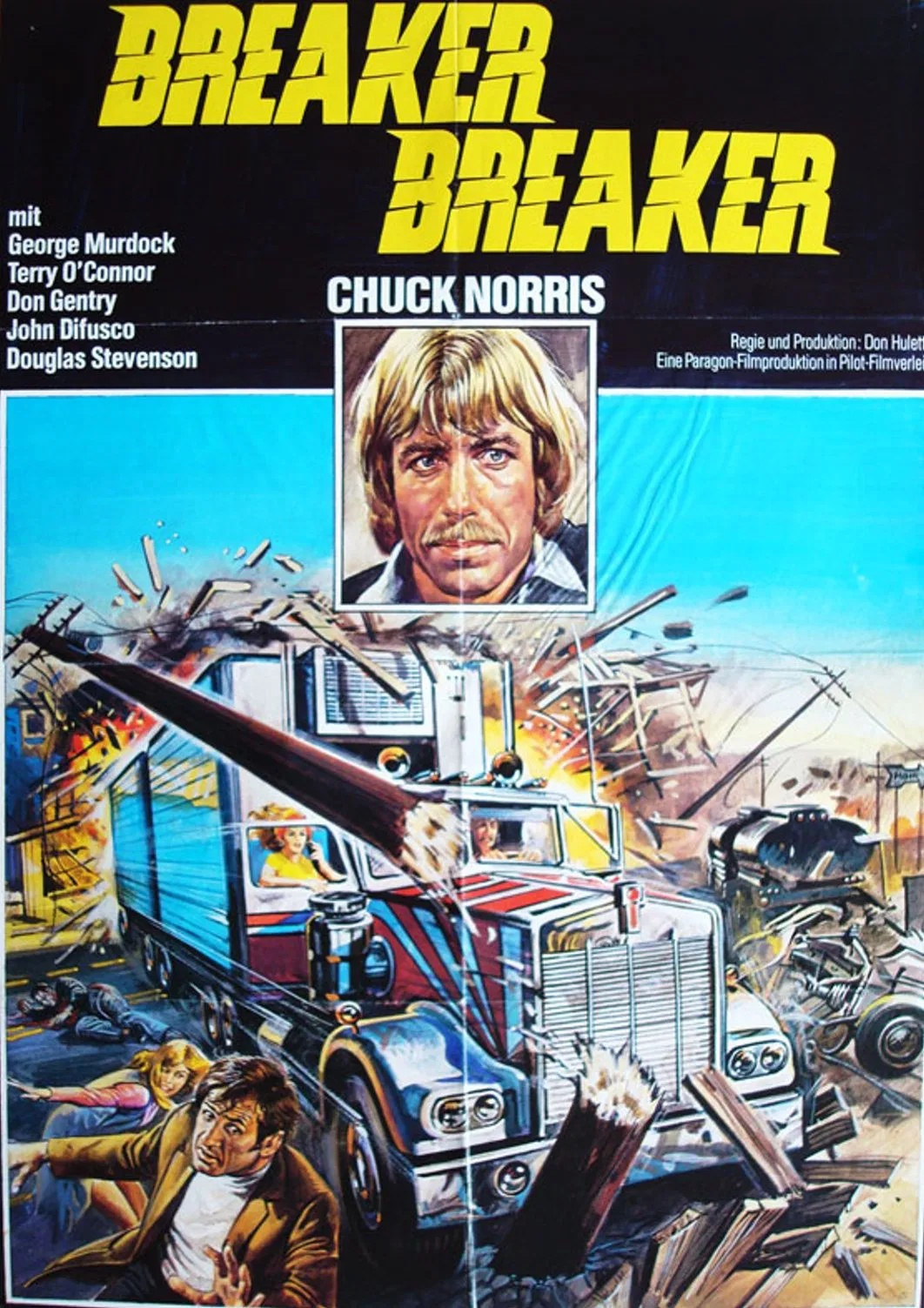
Breaker! Breaker! (1977) Poster
BREAKER! BREAKER! (1977) C−
dir. Don Hulette

Chuck Norris, baby-faced, blond, beardless, and looking fundamentally wrong for the job. The movie can’t decide what to do with him. Though to be fair, this was Norris’ first starring role, and he probably didn’t even know what to do with himself. Is he a stoic martial-arts bruiser? A soft-spoken, CB-radio trucker with romantic appeal? He is both here. Neither works particularly well.

Norris plays J.D. Dawes, a California trucker whose old friend is attacked and whose brother disappears in a dusty pocket of corruption called Texas City (which is, confusingly, located in California). The place is run by Judge Joshua Trimmings (George Murdock), who treats the law like a toll booth—one where the next impounded rig keeps the lights on.

A solid B-movie setup, but Breaker! Breaker! ultimately does very little with it. It bogs itself down with exposition, finds itself short on tension, and gets curiously stingy with action.

What fighting there is gets stretched thin in slow motion, as though the point were Norris’ form rather than the damage it’s supposed to do. Worse, J.D. spends most of the movie trying to reason with corrupt officials instead of flattening them. For anyone showing up to watch Norris clear rooms with a single boot, this plays like a bait and switch.

Terry O’Connor turns up as a waitress and love interest, in a subplot that barely registers. Even J.D.’s missing younger brother (Michael Augenstein) gets more warning than rescue. The movie is short but padded; sincere but oddly bloodless. Even Chuck, when someone calls him “Blondie,” just smiles and lets it go. That might just be the most aggressive move he makes here.

Starring: Chuck Norris, George Murdock, Terry O’Connor, Michael Augenstein, Don Gentry, John Di Fusco, Jack Nance.
Rated PG. American Cinema Releasing. USA. 86 mins.
The Breakfast Club (1985) Poster
THE BREAKFAST CLUB (1985) B+
dir. John Hughes

Five high school stereotypes walk into a library. When they walk out, they’ll all have cried, confessed, bonded, and even knocked out a spontaneous dance number that they’ll deny ever happened by Monday. It’s detention as psychological excavation. Group therapy with a synth soundtrack.

The movie only works if you don’t argue with the setup. Five high school children go to school on a Saturday to serve their time in detention. There’s a brain (Anthony Michael Hall), an athlete (Emilio Estevez), a basket case (Ally Sheedy), a princess (Molly Ringwald), and a criminal (Judd Nelson). All corralled under the flickering gaze of Assistant Principal Vernon (Paul Gleason)—a man whose most immediate offense is his wardrobe. “Does Barry Manilow know that you raid his wardrobe?” the criminal sneers—earning himself another Saturday. But when Vernon leaves the room, the real business begins.

What starts as petty and combative slowly turns into something closer to soul-baring. It’s a leap to believe these five would even acknowledge each other in this setting. Much less unpack their inner lives. The Breakfast Club commits early and doesn’t look back.

The writing stays sharp, and the cast steps up to it. The tone swings from snide to operatic with very little warning, but inside the library it holds. Everyone comes in as a label and leaves a little less sure of themselves.

Even Vernon gets his moment, courtesy of a pointed monologue from the janitor, who turns philosophical right on cue. It’s one of those scenes that shouldn’t work on paper, but lands because The Breakfast Club has already earned a certain emotional elasticity.

The film only stumbles at the end, when romantic pairings are hastily penciled in. Not that such things aren’t expected in teen films, but it’s done so clumsily here that they probably shouldn’t have bothered. But then again, the very last scene is iconic. “Don’t You (Forget About Me)” by Simple Minds strikes up, and Judd Nelson punches the air. Not exactly something you would stay angry at.

Starring: Emilio Estevez, Molly Ringwald, Judd Nelson, Anthony Michael Hall, Ally Sheedy, Paul Gleason, John Kapelos.
Rated R. Universal Pictures. USA. 97 mins.
Breakfast of Champions (1999) Poster
BREAKFAST OF CHAMPIONS (1999) C−
dir. Alan Rudolph

To adapt Breakfast of Champions to film is like trying to put a fence around a daydream. The book wanders. It constantly interrupts itself. Its author, Kurt Vonnegut, keeps inserting himself into the story to change the rules. The novel is populated with characters who aren’t people in the usual sense—they’re demonstrations, stress tests for American excess, loneliness, and bad wiring. Remove Vonnegut’s voice from the story, that running interference, and what you’re left with is a loose crowd of oddballs acting out with no one there to tell you how any of it is supposed to signify.

The movie at least commits to the mess. It dutifully drowns itself in neon, billboards, plastic surfaces, and visual noise, seeming to aim for a kind of satire by way of sensory overload. Sometimes it clicks—in particular, the performances. Bruce Willis stays low-key and disengaged as a car salesman withering into a breakdown, which is about the right temperature for the movie. Nick Nolte, meanwhile, takes the role of a closeted transvestite that easily could have turned cartoonish and gives it some real human grounding. Strong performances and characters, but the film leaves them adrift.

Albert Finney as Kilgore Trout (Vonnegut’s perpetual character who shows up in many of his novels) isn’t around a whole lot. But when he is, the movie behaves. Finney is perfect for the role. Gruff, tired, unimpressed. Looking like someone who’s been watching the country unravel for years while sprawled on a lawn chair and has stopped being surprised by any of it. Once he falls out of the frame, the film does too. That imbalance tells you everything. The film ought to have repurposed Trout to do the work that Vonnegut did on the page. I can picture him holding up a sheet of paper with three intersecting lines, asking us to observe something truly spectacular.

But what we’re left with is an ambitious misfire. Noisy, crowded, occasionally curious, but empty at the center.

Starring: Bruce Willis, Nick Nolte, Albert Finney, Barbara Hershey, Glenne Headley, Lukas Haas, Omar Epps, Buck Henry, Vicki Lewis, Ken Campbell, Jake Johannsen, Will Patton, Chip Zen, Owen Wilson, Alison Eastwood, Shawnee Smith.
Rated R. Buena Vista Pictures Distribution. USA. 110 mins.
Breaking News in Yuba County (2021) Poster
BREAKING NEWS IN YUBA COUNTY (2021) D+
dir. Tate Taylor

This comes in looking like the sort of dark comedy I’ll throw on before dessert. Mean, compact, easy to finish. A suburban farce with a stellar ensemble cast—Allison Janney’s in the mix, which I’m always happy to see. But Breaking News in Yuba County is such a confused, flavorless misfire that it practically begs you to guess what tone it thought it was playing in.

Janney stars as Sue Buttons, a woman so invisible to the world that she’s taken to reciting self-help mantras under her breath—though the panic you can hear in her voice makes it clear that she’s not buying a word of her own gobbledygook.

On Sue’s birthday, which everyone forgets, she walks in on her husband (Matthew Modine) mid-tryst with a coworker. He drops dead right there. But instead of calling for help, she buries him. Along with his phone, wallet, and a duffel bag that unknowingly contains $3 million in cash. Then she spins a story for the police about his disappearance. Why? So someone finally pays attention to her.

There’s certainly a movie in that idea. Fargo already proved it could be done—with teeth. But unfortunately what we get doesn’t seem to know whether it’s a satire, a thriller, or a therapy session for repressed Midwestern rage. It wants to be a dark comedy about ordinary desperation. What it ends up with is a bunch of setups with no timing, and a tone that slips through the film’s fingers every time it reaches for it.

Sue’s lie grows legs, then arms, then media coverage. Meanwhile, a few too many side characters—criminals, cops, relatives—skitter around the edges looking for the plot. The pacing’s slack. The jokes barely qualify. The violence comes and goes without much effect.

The cast is killer, but the movie plays like a satire that’s confused about what it’s aiming at. Attention, denial, the need to be seen. Or perhaps a crime farce. It’s nice and dark, but it’s toothless and doesn’t commit to anything firmly enough to do any real damage.

Starring: Allison Janney, Regina Hall, Mila Kunis, Wanda Sykes, Awkwafina, Matthew Modine, Juliette Lewis, Clifton Collins Jr.
Rated R. American International Pictures. USA. 96 mins.
Breakthrough (2019) Poster
BREAKTHROUGH (2019) B
dir. Roxann Dawson

Faith-based dramas have a habit of talking at their audience, not to them. Preaching. Instructing. Passing out neatly packaged life lessons like a church bulletin no one asked for. But Breakthrough avoids the usual sermonizing. Not by toning itself down. By pushing it to a point where it starts to feel uncomfortable. Faith here isn’t calm or explanatory. It’s loud. It’s stubborn. It’s a woman standing over a lifeless body and refusing to accept what everyone else has already agreed is finished.

John Smith (Marcel Ruiz) was adopted from Guatemala. He lives in a house where faith arrives fully formed and answers come preloaded. At school, he keeps himself small. At home, he does the same. Everyone around him seems very sure about what comes next. John never is. Meanwhile, Joyce is dealing with her own version of displacement. At church, a younger pastor (Topher Grace) takes over—sneakers, polish, and a version of faith she doesn’t respond to.

Then, the accident. John and his friends, ignoring every parental warning about frozen lakes since the dawn of time, crash through the ice. His friends make it out. He does not. When they get John out of the water, too much time has already passed. Well over fifteen minutes beneath the ice. A firefighter (Mike Colter) is the one who finds him. He’s led to a spot he can’t later account for and doesn’t try very hard to explain.

At the hospital, procedures kick in. Compress. Shock. Repeat. Then stop. Forty-five minutes after the fall, the doctors call it. He’s gone. Then Joyce arrives. She prays. She begs God. And miraculously his heart starts beating. The film never questions how or why this happens. It presents it as a miracle and moves forward. Metz plays Joyce as someone who doesn’t argue with science so much as outlast it. And that’s where the film finds its strength. Faith not as quiet acceptance but as raw, unwavering resistance.

Not every choice this film makes works. The medical sequences play fast and loose with realism. Then there’s a subplot that dives into some resentment about John’s survival. Why did God save John over someone else? It never quite finds its footing. But as Christian dramas go, Breakthrough understands something most don’t. Belief isn’t passive. It fights. It pushes. And, in this case, it wins.

Starring: Chrissy Metz, Josh Lucas, Topher Grace, Mike Colter, Marcel Ruiz, Sam Trammell, Dennis Haysbert, Maddy Martin, Isaac Kragten, Nikolas Dukic, Travis Bryant.
Rated PG. 20th Century Fox. USA. 116 mins.
Brewster’s Millions (1985) Poster
BREWSTER’S MILLIONS (1985) B−
dir. Walter Hill

I’ve always been partial to comedies built on rules designed to make people miserable. Brewster’s Millions keeps the premise simple and lets Pryor scramble. He plays Monty Brewster, a broke minor-league pitcher handed an obscene amount of money and a set of rules designed to make him miserable. But it comes with conditions. He’ll only be able to get his hands on the fortune if he’s able to spend thirty million in thirty days and come out with nothing to show for it. No assets. No investments. No clever workarounds. All he’s allowed in the end are the pockets and the clothes he walked in with.

Only Monty and the lawyers are allowed to know the real stakes, which leaves everyone else in his orbit gawking as he torches money on vanity projects, doomed business ventures, and headline-grabbing nonsense. His financial adviser Angela (Lonette McKee) and his best friend Spike (John Candy) think he’s lost his mind. And for most of the movie, they’re not wrong. Pryor plays the scramble beautifully, stuck somewhere between panic and glee as every attempt he makes to torch cash keeps threatening to undo itself.

This story goes all the way back to the Gilded Age—the 1902 novel of the same name by George Barr McCutcheon. The joke isn’t just that money corrupts—it’s that once you have it, the world starts working for you, even to the extent that losing money becomes strangely difficult. That’s a pointed observation, and not a bad one to revive in the Reagan era. But most of the satirical elements are defanged here. This is a friendlier, looser movie. More of a straight-ahead comedy about Richard Pryor spending himself silly. Candy, as ever, is happy to play the baffled bystander.

It isn’t airtight. The jokes don’t cut deep. The romance is there because someone insisted. But the premise is irresistible. Pure fantasy. Being rich enough to fail on purpose. Pryor attacks it with nervous, combustible energy and drags the movie along behind him.

Starring: Richard Pryor, John Candy, Lonette McKee, Stephen Collins, Jerry Orbach, Pat Hingle, Hume Cronyn.
Rated PG. Universal Pictures. USA. 102 mins.
Brian and Charles (2022) Poster
BRIAN AND CHARLES (2022) B−
dir. Jim Archer

Brian (David Earl) invents things. Not useful things. Not even particularly functional things. These include a pinecone bag and an egg belt. Things you don’t need. Things you wouldn’t even want to listen to him talk about. But then he builds something truly amazing. A robot. Brian names him Charles.

Charles has a washing-machine torso, a mannequin head, and talks like he learned English five minutes ago. He speaks. He learns. He develops nuanced opinions about cabbages. And Brian, a man not accustomed to success, suddenly finds himself in possession of something resembling companionship. He’s also built something other people want.

This movie feels like it belongs to an older strain of indie comedy. Back in the mid-2000s when it seemed every film festival had a movie or two about an awkward man in a thrift-store sweater. Brian and Charles reaches for that tradition but never quite relaxes into it. The weirdness feels forced. The kind of careful oddity that expects a laugh simply because a scene looks like something a Wes Anderson character might enjoy.

The film’s logic strains most in its subplot involving a local brute who decides he wants to own Charles for himself. Presumably as some kind of novelty pet for his daughters. It’s one thing for Brian, an endearing loner, to bond with a laundry machine. But it’s another for a seemingly ordinary bully to want the same thing for himself and his family. This ends up stalling the movie far more than it adds to it.

But David Earl carries the whole film on his shoulders. His Brian always looks like he’s waiting for something to go wrong, and Earl doesn’t push the character for sympathy. He’s lonely, but he was already figuring out ways to deal with that before Charles showed up. Charles—part toddler, part malfunctioning Alexa—is a supporting character unto himself. The chemistry between them is what carries the movie. Such a shame that the story itself never quite does them justice.

In the end, a minor curio. Not quite odd enough to feel dangerous. Not quite sharp enough to stick with you. But pleasant, charming company while it lasts—especially if you enjoy deadpan quirk.

Starring: David Earl, Chris Hayward, Louise Brealey, Jamie Michie, Nina Sosanya, Lynn Hunter.
Rated PG. Focus Features. UK/USA. 90 mins.
Brick (2025) Poster
BRICK (2025) C+
dir. Philip Koch

In German

Whatever was left to say between Olivia (Ruby O. Fee) and Tim (Matthias Schweighöfer) gets cut short. Their relationship is through. But when Olivia reaches for the door of Tim’s apartment, she’s greeted by something bizarre: a wall of black bricks. The windows are sealed the same way. Olivia thinks Tim did this somehow. He denies it, of course.

But it quickly becomes evident that Tim couldn’t have done something so elaborate. Because it isn’t just their apartment. When they break through a shared wall between Tim’s apartment and his neighbor’s, they discover that apartment is also blocked off the same way. It’s everywhere they go. In every direction in the apartment building, they find the same dead surface.

It’s a serviceable hook, but Brick isn’t exactly the puzzle box it feels like it’s leading up to being. It’s more like a confinement exercise handled with blunt force. That is, there are walls everywhere, and the characters have a basic, animal urge to get through it all. As Tim and Olivia continue to smash their way through walls and levels, they pick up other trapped tenants along the way—each one arriving with a personality problem and a theory about how to get out. The group dynamic curdles fast.

Someone brings up an old Nazi-era tunnel rumored to run beneath the building. It’s the closest thing to hope this group has clung to, so they might as well check it out and see.

For a while, the movie becomes a matter of logistics. You watch it and try to map out exits for these characters in your head, and the question of what caused this—and how—is interesting enough to keep you watching.

But where Brick goes wrong is that it starts supplying answers. Not because the answers are abstract or unsatisfying, necessarily, but because they’re disconnected from the people trapped inside. This isn’t the fallout from one of their bad decisions or a buried secret. Nor is it consequence or punishment. It’s simply something imposed on them.

As a Netflix watch, it moves easily enough. The hook carries it for a while. The problem comes afterward. Even the hook loses its luster, and there’s nowhere left for the movie to go.

Starring: Matthias Schweighöfer, Ruby O. Fee, Frederick Lau, Salber Lee Williams, Murathan Muslu, Sira-Anna Faal, Axel Werner, Alexander Beyer.
Rated TV-MA. Netflix. Germany. 99 mins.
Bridesmaids (2011) Poster
BRIDESMAIDS (2011) A−
dir. Paul Feig

The movie isn’t really interested in the wedding. At least not as much as its own characters. It’s more concerned in chronicling social catastrophe. It keeps a running catalog of personal implosions—staged in front of increasingly large groups of witnesses. This is a comedy that lives in embarrassment—something perfectly in Kristen Wiig’s wheelhouse. She plays Annie, a baker whose career is over and whose footing is worse. When her best friend Lillian (Maya Rudolph) gets engaged, Annie assumes she’s still central to the story. She isn’t.

Helen (Rose Byrne) enters the picture already polished, and frictionless. And suddenly what used to be easy between Annie and Lillian starts to feel like a contest. Helen isn’t trying to be cruel necessarily—even if she not-so-secretly wishes she had Annie’s status as maid of honor. Helen is just operating with advantages. Mainly financial ones. Her budget is unlimited. She pays for the spa treatments. She plans the destination bachelorette to Las Vegas. Things Annie couldn’t begin to afford. And she can feel herself slipping out of step in Annie’s life.

Paul Feig’s direction helps here. Scenes aren’t hurried along just to get to the joke. The embarrassment has time to sit, to curdle, to get uncomfortable. And Bridesmaids doesn’t soften its gross-out instincts just because this is female-led or to make the medicine go down easier. It’s not a movie that apologizes for the mess. It just reallocates it.

The ensemble clicks like a well-armed unit. Melissa McCarthy shows up like a weapon. A star-making performance that put her on the map. McLendon-Covey carries herself like someone constantly swallowing rage. Kemper blinks slowly like she’s one surprise away from short-circuiting. Chris O’Dowd plays the one person who isn’t treating Annie like a spectator sport. And, somehow, he makes romantic interest in a human catastrophe seem like a good idea.

It runs long, and a few jokes drop out along the way. But when something works, it works cleanly. Bridesmaids understands that watching people implode only pays off if you don’t rush them through it. Scenes are allowed to sit there and get uncomfortable. Nothing is softened or hurried along, and that patience is what gives the comedy its bite.

Starring: Kristen Wiig, Maya Rudolph, Rose Byrne, Melissa McCarthy, Wendi McLendon-Covey, Ellie Kemper, Chris O’Dowd, Jill Clayburgh, Matt Lucas, Rebel Wilson, Michael Hitchcock, Tim Heidecker, Ben Falcone.
Rated R. Universal Pictures. USA. 125 mins.
Bring It On (2000) Poster
BRING IT ON (2000) B+
dir. Peyton Reed

Bring It On is perky and sugar-coated. A movie set in the world of high school competitive cheerleading. It opens with a cheer routine that’s aggressively juvenile, and it more or less stays in that mode from there. But stick around a little longer, and the film also starts showing its edges. Ultimately revealing itself to be a surprisingly prickly satire about who gets rewarded, who gets copied, and who gets ignored.

On one level, Bring It On is easy fun. Glittery routines. Big smiles. Athletic choreography performed under the polite fiction that it’s “all in good fun.” But in the world of competitive cheerleading, winning is the point. The competition is ruthless. Polish gets rewarded. Access to money matters.

Kirsten Dunst plays Torrance Shipman, the new captain of a team that’s never had to question its success. From the outside, the wins look clean. But Torrance is quick to discover that there’s rot beneath the surface.

It comes down to their routines. The ones they’ve been winning with aren’t even theirs. They were lifted wholesale from the Clovers—a predominantly Black squad doing the hard work without the funding, the facilities, or the visibility. Gabrielle Union shows up as Isis, the Clovers’ captain and Torrance’s chief rival. Isis has no interest in easing Torrance’s conscience.

Torrance knows her squad can’t keep using stolen routines, but she’s also out of time. So she does what comes easiest. She throws money at the problem, hiring a choreographer whose routines look slick and expensive but don’t feel like much else. The Toros still sparkle, but they nearly get disqualified—hiring a choreographer is against the rules.

The comedy throughout the film is scattershot. Some jokes feel cheap and tossed off. A few—especially the homophobic ones—have dated so badly they’ll make any decent person cringe. But the movie never pauses to apologize or explain itself. It just keeps moving, and for every joke that doesn’t work, there are two more right behind it that do.

What’s surprising, given the movie’s unserious veneer, is how pointed the satire turns out to be. Beneath the chants and backflips is a clear-eyed look at how often “tradition” is just theft that’s gone unchallenged long enough to feel official. Not to mention the sheer ridiculousness of competitive cheer to begin with. (I’m not knocking the sport, mind you. I often spend time doing even more useless things.) Bring It On sells itself as fluff, but if you dig just a little beneath the surface, you might find yourself taken aback by how sharp its teeth actually are.

Starring: Kirsten Dunst, Eliza Dushku, Jesse Bradford, Gabrielle Union, Clare Kramer, Nicole Bilderback, Tsianina Joelson, Rini Bell, Nathan West.
Rated PG-13. Universal Pictures. USA. 99 mins.
Broadway Limited (1941) Poster
BROADWAY LIMITED (1941) C+
dir. Gordon Douglas

A screwball comedy about miscommunication, a missing baby, a wild publicity stunt, and so much chatter that you’d swear that its energy alone—as opposed to coal—was enough to keep the Broadway Limited running. (That was a real train, by the way—New York to Chicago, 1912 to 1995. In case you were wondering.)

Marjorie Woodworth plays April Tremaine, a movie star whose career could use a bit of a boost. Her excitable director, Ivan Ivanski (Leonid Kinskey, fond of grand gestures and rolled R’s), dreams up a plan to make her seem more relatable. Let her carry around a baby for a while. Let the press take pictures. Wait for America to swoon. Great plan. Except for one small hitch. They don’t have a baby. But, well, details.

Mike Monohan (Victor McLaglen) runs the train—a full-time job, you’d think. But somehow he still gets roped into bringing the baby onboard and smuggling it across state lines. He assumes it’s for a film shoot or something harmless. Not, say, a kidnapping. Except, surprise, it’s a kidnapping. The baby’s from a rich family, and the story’s splashed all over the papers. (Easy mistake to make. Back in those days when you could go in the back of any gas station and find a cardboard box full of babies labeled “Free to a good home.” Who could be expected to tell a free baby from a not-free baby just by looking at it?)

Meanwhile, there’s a persistent doctor (Dennis O’Keefe) who keeps showing up to ask obvious questions. For example, why is Hollywood’s sweetheart suddenly traveling the rails with an infant? April is all too eager to brush that nosy Nellie off and just tell him whatever it takes to leave her alone. Which is anything except for the truth. Pretty soon the rumor mill’s spinning—half-heard whispers, sideways glances, wild theories breeding faster than sense. Everyone’s convinced they’ve got it figured out. Except nobody does.

While this might be a fun ride for screwball completists, everyone else might be better off waiting for the next train. It has plenty of energy, but not a whole lot of laughs to show for it. A farce that, at worst, is noise and at best is people talking over each other.

Starring: Marjorie Woodworth, Victor McLaglen, Dennis O’Keefe, Leonid Kinskey.
Not Rated. United Artists. USA. 77 mins.
Bruce Almighty (2003) Poster
BRUCE ALMIGHTY (2003) B−
dir. Tom Shadyac

Give Jim Carrey godlike power, and he’ll use it to prove that slapstick was created in his image. He plays Bruce Nolan, a Buffalo newscaster stuck covering puff pieces when he’d much rather be a serious anchor. His universe caves in right there on air—smack in the middle of a story about a giant cookie—when the station announces that his smug rival, Evan Baxter (Steve Carell), got the anchor job that he’s been gunning for.

And Bruce takes that about as well as a toddler who is denied dessert. Full tantrum. Meltdown. Potty words. And it all ends with him getting a time-out. (Or getting fired, in his case.)

So Bruce is furious. At the world, at God. He looks up, screams at the sky—and lo and behold, who answers? God himself. In the form of Morgan Freeman. He comes pressed in white linen and armed with the patience of a saint. He has an offer for Bruce: omnipotence. No fine print.

Bruce suddenly finds himself divine and spectacularly unwise. He treats the universe like a toy fresh out of the box. One flick and the traffic clears. A wave of the hand and his tomato soup parts like the Red Sea. He even reels the moon in closer to impress his girlfriend, Grace (Jennifer Aniston). (She’s not impressed. In one of the film’s more formulaic subplots, she just wants the man who’s underneath the miracles.)

The bigger the miracles get, the smaller Bruce becomes. Revenge, showboating, a few tweaks to his love life that never quite take. He gets the smug Evan back, in a scene-stealing moment on Carell’s part, who is forced to babble uncontrollably on air. Then come the voices in Bruce’s head. All the prayers in the world come flooding in at once. And Bruce figures out that even God can’t solve everyone’s problems.

The film strikes an agreeable balance that holds for a while. Faith, farce, a little of Carrey’s rubber-faced showmanship. But then the sermon creeps in. And the humor flattens. Suddenly I’m not watching a Jim Carrey movie—it feels like I stepped into Sunday School. Lessons in bold lettering. Power needs humility. Love can’t be forced. And God’s not on call to help you find a better parking spot.

It’s not a great film. If isn’t even great Carrey. But it’s steady. Carrey has the charm and manic energy to keep the whole thing bouncing along, while Freeman makes divinity sound like someone you’d actually take advice from. And if nothing else, it drives home a truth that the Rolling Stones have already driven into our subconscious. You can’t always get what you want—but if you try sometimes, you just might find, you get what you need.

Starring: Jim Carrey, Jennifer Aniston, Morgan Freeman, Philip Baker Hall, Catherine Bell, Lisa Ann Walter, Steve Carell, Nora Dunn.
Rated PG-13. Universal Pictures. USA. 101 mins.
The Brutalist (2024) Poster
THE BRUTALIST (2024) A−
dir. Brady Corbet

Some films build outward. They tell stories about characters who expand as their universe opens before them. The Brutalist builds inward. Into walls. Into silence. Into the narrow space where ambition goes to die.

László Tóth (Adrien Brody). Hungarian-Jewish. World-class architect. He survives the camps and sails for America with his pregnant wife (Felicity Jones) and a portfolio of modernist designs. The work is pure geometry—precise, stripped down, nothing ornamental. That’s how his eye works now. Even freedom looks like form. When the Statue of Liberty slides closely past his window it appears to him—from his perspective—upside down.

László is chasing freedom. But not the kind he thought he was getting. The so-called Land of Opportunity and the American Dream sound nice for words, but let’s see how they hold up when you try living them. László comes to the country expecting his world-class skills to be put to use right away. But it turns out America doesn’t reward talent for its own sake. America only rewards what sells. So the question becomes this: are you truly living the American Dream if you’re not fulfilling your own dream but rather someone else’s?

László takes whatever work he can find—manual labor, drafting, anything to keep his family alive. But then he catches a break. A patron appears. Harrison Lee Van Buren (Guy Pearce) wants a library, then a house, then a legacy. He gives László money and a studio. The American myth might finally be taking shape. But László realizes, slowly, that what’s inside is hollow. The partnership isn’t so much salvation as it is surveillance. The film spans decades of this quiet surrender—success turning to routine, routine into dependence.

Brody, who won his second Oscar for this performance, plays this containment. His voice low, posture measured, emotion rationed, accent flawless. Felicity Jones, as his wife Erzsébet, provides the hairline cracks where the film’s rare allotment of warmth is allowed to seep through. Pearce makes Van Buren the kind of man who mistakes taste for virtue and ambition for grace.

Corbet builds the movie the way László builds his structures: perfectly, and at the expense of air. It’s a long film—nearly three hours, if you’re counting—and Corbet lets it stretch. Scenes play out with meticulous patience, every shot aligned to something immovable: beauty, discipline, maybe fear. The precision is hypnotic.

A movie that will get you in the slow burn. You might even feel it start to sting. Because what happens to László happens, in much quieter ways, to everyone. We all (or most of us) make the same bargains. Trading pieces of ourselves for comfort, for permission to belong. It just so happens that László’s manifestation of the surrender comes in the form of concrete monuments.

Starring: Adrien Brody, Felicity Jones, Guy Pearce, Alessandro Nivola, Stacy Martin.
Rated R. A24. USA. 166 mins.
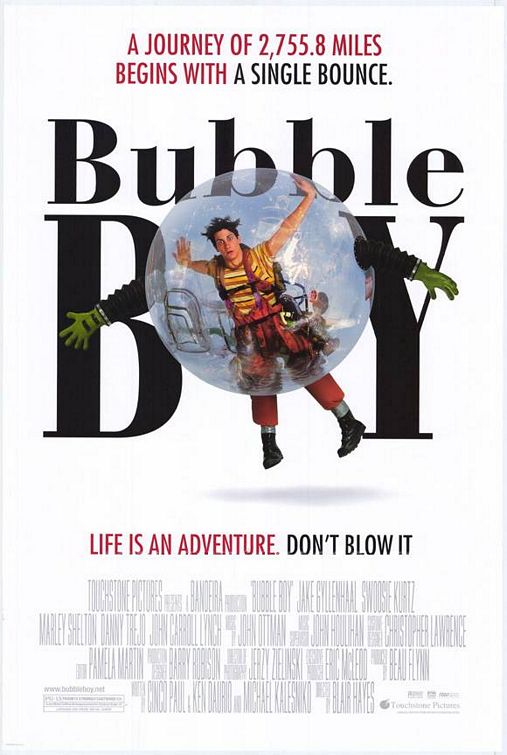
Bubble Boy (2001) Poster
BUBBLE BOY (2001) C−
dir. Blair Hayes

It’s one thing to be overprotective. It’s something else entirely to shrink-wrap your kid. Jimmy Livingston (Jake Gyllenhaal) is eighteen and has a severely compromised immune system. Should he get just one whiff of pathogen-infected air, he’s done for. Convenient, really, as far as his hyper-religious mother (Swoosie Kurtz) is concerned. She would’ve kept him sealed up anyway—healthy or not. To her, the entire world’s a contagion. Not just germs. But books. Rock ’n’ roll music. Girls. Especially girls.

So Jimmy grows up spotless, temperature-controlled, and Bible-certified. The world outside might as well be Mars to Jimmy. But then Chloe (Marley Shelton) appears. She’s the girl next door. Tan, funny, stunningly beautiful, and somehow interested in him. But Jimmy, of course knowing what his mother has been telling him all along about girls, ends up freezing. And Chloe moves on.

Years later, she’s engaged. Niagara Falls. The wedding’s happening. Jimmy’s been stewing in his bubble this whole time, marinating in regret. Figures this might be his one shot at something like a life. So he does what any self-respecting Bubble Boy would. He builds a portable bubble, grabs a compass and roadmap, and rolls for the Honeymoon Capital. (Eat your heart out, Dustin Hoffman—from The Graduate. Same mission, less plastic. Amazingly.)

What follows isn’t so much a road trip as a string of detours. Pee-wee’s Big Adventure had the same idea—only its detours were actually funny, and they still felt like they were overall in service to the story. The detours in Bubble Boy never really build on top of each other. They just appear and disappear, like someone flipping channels mid-story. He runs into a cult led by Fabio. Danny Trejo’s biker gang. A panicked hitchhiker (Brian George). A Hindu goofball (Brian George) who freaks out about cows. An Asian carnival worker (Ping Wu) whose only line—“five hundred dollah!”—gets repeated so often that you start to get a little delirious yourself. Each new stop resets the movie like someone shaking a snow globe—everything moves but seems to just drop back where it was. (Not to mention, it’s a bit racist.)

The one thing that almost saves it is Gyllenhaal. Wide-eyed, earnest, and totally sold on the fantasy. The movie should’ve followed his lead. He gives a sharp and funny performance. Too bad it’s trapped inside a movie that’s too busy tripping over its own premise to truly recognize it.

It’s clear what this movie was going for—an offbeat adventure with heart. But just because “offbeat” implies there should be something off about the beat, it didn’t mean the movie shouldn’t have found a rhythm. While every once in a while it hits something funny—a stray moment or a throwaway line—they come merely as flashes. This is a movie that wants so badly to chase quirkiness. But instead of ever finding traction, it slowly deflates.

Starring: Jake Gyllenhaal, Swoosie Kurtz, Marley Shelton, Danny Trejo, Brian George, Fabio, Ping Wu, Zach Galifianakis.
Rated PG-13. Touchstone Pictures. USA. 84 mins.